
In medical billing, we spend considerable time discussing claim denials, reimbursement rates, coding accuracy, and accounts receivable. But what happens after an insurance company processes and pays a claim?
A recent operational scenario involving Medicare supplemental insurance plans highlights an overlooked revenue cycle gap: electronic payment and remittance enrollment.
Two Payers, Two Enrollment Gaps
During a routine accounts receivable review, a billing team identified that a medical practice needed electronic payment and remittance arrangements with two supplemental insurance payers. For one payer, both Electronic Funds Transfer (EFT) and Electronic Remittance Advice (ERA) enrollment were requested. For another, the immediate requirement was ERA enrollment.
Although Explanation of Benefits documents were available, one enrollment required confirmation of the correct payer identifier before processing could continue. This small operational detail illustrates a larger point: a claim can be processed correctly while payment reconciliation remains inefficient.
What the Office Ally Payer List Shows
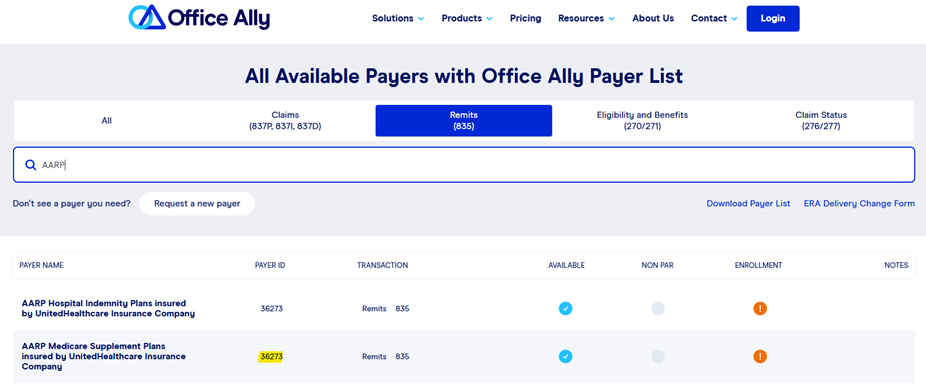
The accompanying Office Ally payer-list screenshot shows AARP Medicare Supplement Plans insured by UnitedHealthcare Insurance Company under payer ID 36273 for the 835 remittance transaction. The enrollment indicator highlights the need to check applicable enrollment requirements. Payer identifiers and enrollment steps should always be verified against the current clearinghouse and payer instructions.
Why EFT and ERA Matter
EFT allows insurers to deposit claim payments into the provider’s designated bank account. ERA provides electronic payment and adjustment information, commonly using the ANSI X12 835 transaction, so a practice management system can support automated posting.
Without an effective ERA workflow, billing teams may have to retrieve remittance documents, interpret adjustments, enter payments, and reconcile balances manually. That extra work can distort accounts receivable reporting and slow the identification of genuinely unpaid claims.
A Paid Claim Can Still Look Outstanding
If a payer has issued payment but the remittance has not been posted, the billing system may continue to display an outstanding balance. Staff might pursue unnecessary payer follow-up, patient balances may be inaccurate, and management may make decisions using outdated financial reports.
Not every outstanding AR balance represents money the insurance company still owes. Some balances are posting or reconciliation problems, not reimbursement problems.
Why the Correct Payer ID Matters
Payer IDs are electronic routing identifiers, not confidential patient information. But an identifier must match the relevant clearinghouse, transaction type, and enrollment process. An incorrect selection can delay enrollment or cause transactions to route incorrectly.
Submitting an enrollment request is not the same as confirming an active, functioning EFT or ERA connection.
Six Controls Every Practice Should Review
- Confirm EFT enrollment is active and deposits reach the correct bank account.
- Verify ERA enrollment is active and 835 files reach the intended clearinghouse or practice management system.
- Validate payer identifiers separately for the relevant transaction types.
- Reconcile bank deposits, remittances, and posted payments.
- Investigate paid-but-unposted claims before pursuing payer collections.
- Track pending enrollments through activation, testing, and assigned ownership.
The Question Practice Owners Should Ask
When was the last time your billing team reviewed EFT and ERA enrollment status across every active payer, including Medicare supplemental plans?
Successful revenue cycle management is not just about getting claims paid. It is about ensuring every payment is received, recorded, reconciled, and accurately reflected in the practice’s financial reports.
RCM Navigator | U.S. Healthcare Revenue Cycle Management Insights