
By Sadia Batool | RCM Consultant | Anesthesia Denial Insights
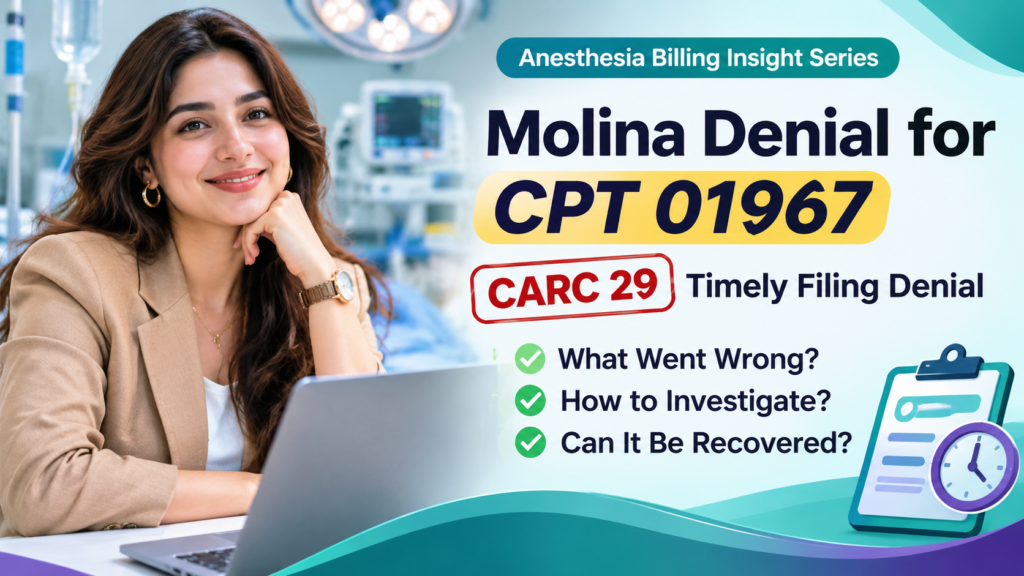
A labor epidural service is performed, the anesthesia record is completed, and CPT 01967 is billed. Then Molina Health Plan returns a denial: CARC 29, the time limit for filing has expired. Should the practice simply write off the balance? Not before establishing what actually happened to the claim.
Timely filing problems can arise from delayed documentation, rejected electronic claims, payer routing errors, corrected-claim workflows, or an incorrectly applied deadline. The right response starts with evidence, not automatic resubmission.
Case context: This article addresses a real payer, CPT, and denial combination from an anonymized anesthesia billing assessment. The workflow below explains recommended investigation and correction steps; it does not claim a documented successful recovery or identify any practice or patient.
Understanding CPT 01967
CPT 01967 describes neuraxial labor analgesia or anesthesia for planned vaginal delivery. Accurate billing depends on documented services, anesthesia time, provider participation, applicable modifiers, and payer requirements. Even a clinically supported claim can be denied because of an administrative filing deadline.
What CARC 29 Actually Means
CARC 29 means the time limit for filing has expired. It does not establish that the anesthesia service was medically unnecessary or incorrectly coded. The question is whether the relevant Molina plan received an acceptable claim within its applicable filing period and whether an exception or review pathway exists.
1. Identify the Exact Molina Product
Confirm whether the coverage is Medicaid managed care, Marketplace, Medicare-related, or another Molina product. Filing limits can vary by product, jurisdiction, contract, and claim type. Verify the actual rule before calculating the deadline. Do not assume one national Molina filing limit.
2. Reconstruct the Claim Submission Timeline
Compare the service date, charge release, initial transmission, clearinghouse response, payer acknowledgment, rejection dates, resubmissions, and adjudication. A practice-management status marked “submitted” does not necessarily establish payer receipt. Look for the precise point at which the claim stopped progressing.
3. Preserve Proof of Filing
Review clearinghouse records, 999 acknowledgments, 277CA claim acknowledgments, and payer claim status. These records serve different functions. A 999 acknowledgment can confirm transaction-level processing but does not alone prove acceptance of the individual claim for adjudication. Preserve evidence showing the payer received the claim within the applicable deadline when available.
4. Distinguish Rejected, Corrected, and Appealed Claims
A claim rejected before payer acceptance may not preserve timely filing rights. A payer-accepted original claim followed by a corrected claim presents a different issue. Check corrected-claim deadlines, original claim references, resubmission requirements, and whether the appropriate action is correction, reconsideration, or formal appeal.
5. Check Coordination of Benefits
When another payer processed the claim first, verify whether the specific Molina plan provides a secondary filing rule triggered by primary adjudication. Preserve the primary payer remittance and relevant submission dates. A primary payer EOB does not automatically create a filing exception.
6. Decide Whether Reconsideration Is Supported
A dispute may be appropriate when evidence supports timely payer receipt, a recognized exception, or a payer processing error. Follow the product-specific appeal channel and its own deadline. Submit a concise explanation with the relevant acknowledgments, payer references, and remittance records. If the claim was genuinely late and no exception applies, document the finding and apply contractual and patient-billing restrictions before any adjustment.
7. Prevent Repeat Timely Filing Denials
Build controls for incomplete anesthesia documentation, unbilled services, verified payer-specific filing deadlines, rejected claims, corrected claims, and escalation ownership. Monitor claims nearing their deadlines and audit whether rejection queues are resolved. Prevention requires accountable workflow changes, not merely faster data entry.
What This Says About Your Billing Company
A single CARC 29 denial does not justify changing billing vendors. Repeated denials without a traceable claim history, evidence review, deadline controls, or corrective action may indicate a wider revenue cycle problem. Ask your billing team who owns rejected claims, how payer deadlines are verified, and how avoidable write-offs are approved.
Frequently Asked Questions
Can a Molina CARC 29 denial be appealed?
Possibly. Appeal rights depend on the specific plan, governing rules, evidence, and applicable deadline. Payment is not guaranteed.
Does a clearinghouse acceptance prove timely filing?
Not necessarily. Review the actual acknowledgment type and payer acceptance status.
Does CPT 01967 itself cause CARC 29?
No. CARC 29 concerns filing time limits rather than the clinical meaning of the CPT code.
Should the practice immediately write off the claim?
Not before verifying submission history, available review rights, contractual obligations, and the practice’s approved adjustment policy.
Is Your Anesthesia Billing Partner Investigating Denials or Simply Resubmitting Claims?
Effective denial management requires a documented submission trail, payer-specific rules, appeal triage, and prevention controls. Sadia Batool provides U.S. healthcare revenue cycle support including anesthesia claim review, denial investigation, AR follow-up, appeals preparation, and workflow improvement. Explore RCM services or discuss your practice’s billing challenges. Do not send patient information through the general contact form.
More Anesthesia Denial Insights Are Coming
This is the first in an ongoing series examining one payer, one CPT code, and one denial category at a time. Future articles will address anesthesia procedure bundling, missing documentation, diagnosis inconsistencies, authorization denials, and qualifying circumstance reimbursement. Each will explain what the payer response means, what to verify, and which corrective pathways may be appropriate.
Editorial note: The exact Molina product, provider agreement, and current filing and appeal policy must be verified before applying these steps to an individual claim. No collection outcome is guaranteed.