
Imagine receiving a letter from your insurance payer demanding nearly $67,000 back for claims your practice submitted and was already paid for.
Now imagine discovering that the problem was not necessarily incorrect coding or services that were never performed. The payer simply never received the medical records it had requested.
This is exactly the kind of situation that should concern every physician and practice administrator. A recent CareSource audit involving three commonly billed procedure codes offers an important reminder that getting claims paid is only one part of protecting a practice’s revenue.
How a Routine Medical Records Request Turned Into a $67,000 Recovery Demand
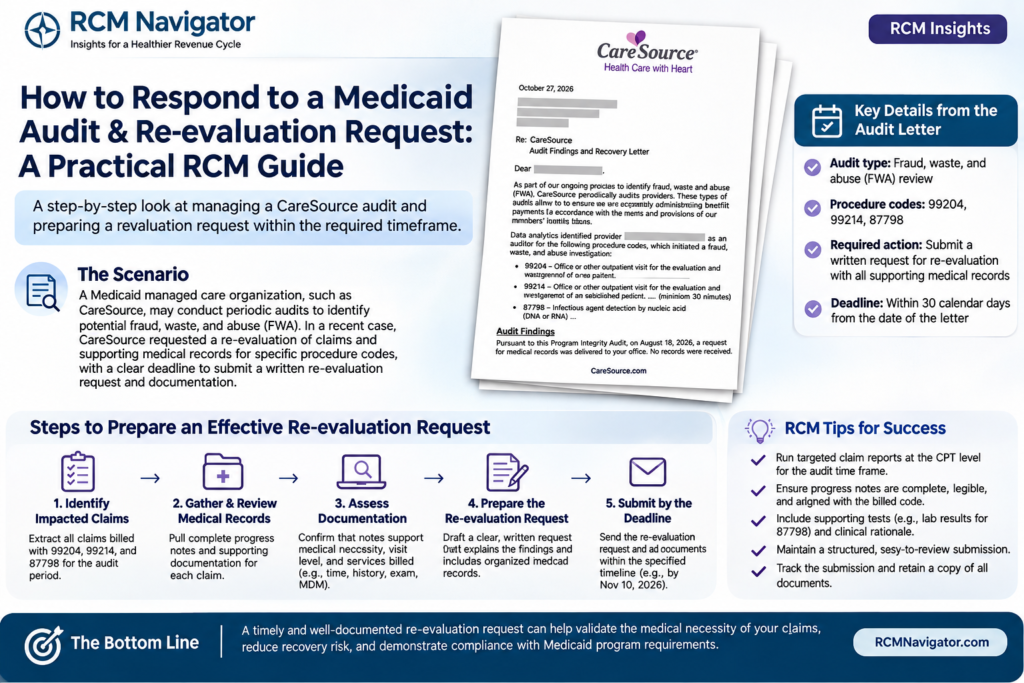
In October 2026, CareSource issued an audit findings and recovery letter demanding approximately $67,000 in previously paid claims. The review involved services billed between January 17 and June 27, 2026, under CPT codes 99204, 99214, and 87798.
CPT 99204 describes a new patient office or outpatient evaluation and management visit. CPT 99214 describes an established patient office or outpatient evaluation and management visit. CPT 87798 concerns infectious agent detection using nucleic acid testing.
According to the payer’s correspondence, medical records had been requested in August 2026. Follow up attempts were made in September, but the requested documentation was not received. CareSource subsequently stated it could not verify whether the services had been rendered as billed and issued a demand for repayment.
Here is what makes this case particularly important. The recovery demand was based on the absence of supporting medical records. The letter did not establish that every service was medically unnecessary or improperly billed. That distinction matters.
A medical practice may have provided legitimate services, documented the encounters, and received appropriate reimbursement. However, if those records are not produced when requested, the practice may still face significant financial exposure.
Getting Paid Does Not Mean the Claim Is Safe Forever
Many physicians understandably assume that once an insurance company processes and pays a claim, that transaction is complete. Unfortunately, that is not always how medical billing works.
Insurance companies conduct retrospective reviews to verify whether previously paid claims meet applicable coding, documentation, medical necessity, and contractual requirements. These reviews may occur months or even years after the original payment, subject to the applicable rules and agreements.
A practice might have excellent collections, a low denial rate, and an experienced billing team, yet still face substantial recoupments if it cannot retrieve the records needed to support its claims. This is why revenue cycle management should never stop at payment posting. Protecting collected revenue is just as important as collecting it.
The Real Problem May Be Communication, Not Clinical Documentation
Consider how medical records requests are handled in a busy physician practice. A letter arrives at the front desk. Someone forwards it to the office manager. The office manager assumes the billing company will handle it. The billing team believes the clinical staff is preparing the records. Meanwhile, the deadline continues approaching.
Eventually, everyone discovers that nobody actually submitted the requested documents. This is an illustrative scenario, not a confirmed account of what occurred in the CareSource case. However, it demonstrates why clearly assigned responsibilities matter.
A payer audit should never depend on assumptions about who is handling the request. Someone must own the process from the day the letter arrives until the payer confirms receipt of the response.
What Should a Practice Do After Receiving a Recovery Letter?
The first reaction should not be to immediately issue a refund or send a generic appeal. The practice needs to understand exactly what the payer is questioning and whether the available medical documentation supports the services billed.
Start by identifying every affected claim
The billing team should extract claims at the individual CPT level, identify associated patients and dates of service, and reconcile payments against the amount the payer is seeking to recover. If the payer has not supplied a detailed claim list, the practice should request one while continuing its own review.
Review the actual medical records
Having a progress note in the electronic health record does not automatically mean the documentation supports the claim. For evaluation and management services, the documentation should support the reported level through the applicable medical decision making or time requirements. For laboratory testing, the record should establish what was ordered, what was performed, and whether the billed service is supported.
Prepare a meaningful re-evaluation request
A strong response explains why the practice disagrees with the findings and connects supporting records to the claims being reviewed. It should be organized, specific, and supported by evidence. If records were previously submitted, the practice should preserve any available transmission confirmations. Documentation should never be fabricated, backdated, or improperly altered after the fact.
The Deadline Can Be Just as Important as the Documentation
The CareSource letter provided 30 calendar days from the date of the letter to request re-evaluation with supporting documentation. It also warned that failure to repay or submit a formal request within the required period could result in recovery from current or future claim payments.
Think about what that could mean for a smaller medical practice. Payroll, rent, supplies, and other operating expenses continue regardless of whether an insurer is recovering previously paid claims. A sudden reduction in insurance payments can create immediate cash flow pressure.
A Simple Change That Could Protect Thousands of Dollars
Every medical practice should have a clear process for managing payer audits and medical records requests. It does not have to be complicated. The practice needs a central location for incoming audit correspondence, a responsible person to monitor deadlines, a reliable way to retrieve supporting records, and a process for confirming successful submission.
The billing team and clinical office must communicate throughout the review. A claim report tells you what was billed and paid. A medical record tells you whether the service is supported. Neither is sufficient by itself when a payer is questioning previously paid claims.
A Message to Physicians and Practice Owners
If your billing reports show healthy collections, that is encouraging. But there is another question worth asking your billing manager: If an insurance company requested the medical records for 100 previously paid claims tomorrow, how quickly could your team identify those claims, retrieve the documentation, and prepare a complete response?
If nobody can answer that question confidently, your practice may have an operational weakness that deserves attention. The nearly $67,000 recovery demand in this case demonstrates how expensive an unresolved documentation request can become.
It does not establish that the full amount will ultimately be recovered, nor does it prove that the underlying services were incorrectly billed. What it does show is that the ability to respond to an audit can be just as important as the ability to submit a clean claim.
Revenue cycle management is not only about getting your claims paid. It is also about making sure your practice can defend the revenue it has already earned.
At RCM Navigator, we examine real revenue cycle challenges and share practical insights to help healthcare providers understand payer requirements, improve billing operations, and protect their practice revenue.
This article discusses an anonymized payer audit scenario for educational purposes. It does not identify the healthcare practice or patients involved and should not be interpreted as legal advice.